
WEB
JOURNAL
Q&A with Yours Truly
The first hundred pages are the hardest. Everything is set up in those chapters—the protagonist, the supporting cast, the mystery, the dynamics. These first pages take the majority of my time. I do a lot of staring out the window.
In response to some of the questions I’ve received from readers over the years, here is a little Q&A to help you get to know me. Have other questions? Drop me an email and I’ll post answers in the next installment. Happy Reading.
How would you describe your writing process?
The first hundred pages are the hardest. Everything is set up in those chapters—the protagonist, the supporting cast, the mystery, the dynamics. These first pages take the majority of my time. I do a lot of staring out the window. And I'm always writing down little nuggets. I keep notebooks everywhere!! And I encourage other writers to do the same. In particular, keep a pen and paper by your bed, since the best ideas always seem to come as you’re falling asleep. Your mind relaxes and that in-between stage can be magical for brainstorming.
In the beginning, I compile those ideas, create some spreadsheets because I'm weird that way, AND, most importantly, I stumble through a thousand words of writing each day. Many of those might get cut, but even if I'm writing backstory or character information, it's still worthwhile.
Sound painful? It can be. Like moving one inch forward then two feet backward. But, if you can get those first hundred pages right, it’s all there. After that, it comes to writing every day, since it can be hard to get back into the flow if I let the story sit, even for a day.

Do you ever base characters on real people?
I've never based a character on someone specific, but I think the characters are probably a collage of people I know or have met. It would be hard to create characters without stealing traits from real people as a guide—how else would I know where to start? Beyond that, many—if not all—of my characters also include a sliver of my own personality, or someone I would like to be.
What is your advice for aspiring writers?
Despite what people think, there’s nothing sexy or romantic about being a writer. Writing a book is like exercising—everyone wants to do it once and see the result but it's really about consistency and making it a habit. If you do put in the work, eventually you’ll get the reward, but it’s a long slog. No one starts off knowing how to write well.
At the beginning of my career, when I was still working in finance, I wrote three suspense novels, which I sent to agents and editors. This was back when we mailed query letters at the post office. I got a lot of rejections.
One rejection on the first book, “Murders and Acquisitions,” said something along the lines of, "The title is great. The rest is not." I probably don't need to tell you that none of those book sold. They're permanently "buried in the backyard," as I like to put it. That's okay. Whether it was stubbornness or sheer stupidity, I kept writing. Sent a book out, collected rejection letters while I was starting the next one. Rinse and repeat.
The only way to get better is to write. Malcolm Gladwell's book Outlierssuggests that gaining expertise takes 10,000 hours. I think he's right. I've spent that much time writing now. So, you want to be a writer? Get your 10,000 hours.
The other thing about this business is that you’re going to have to deal with rejection. From the industry, from fans, and occasionally from a less-than-tactful friend. You can’t stop for any of that. Your job is to write. When you’re done with book one, write another book. Worst case scenario (or best case scenario, depending on how you look at it) you’ll have 3 or 4 books ready to sell when you land that perfect agent. But you can’t give up. The only way to guarantee you’ll never make it is to quit.
It helps to have people in your life who help you keep going. I’ve had the good fortune of being with my husband for 25 years, and he’s been an incredible and encouraging foundation. Being a writer involves a lot of jumping and trusting you’ll land somewhere safe, so it is important to surround yourself with people who will support the process, even if they don’t understand it.
Do you read reviews of you books? Do they affect you?
Yes, I read them and I hate them. The fact is that the most successful books in the marketplace, the ones that people are drawn to, receive the strongest reactions, and they’re not all positive. If you’re writing material that some people really love, the chances are that someone else is going to really hate it. The truth is you just can’t let those reviews affect how you write. Constructive reviews can be helpful on a purely mechanical level, but stylistic ones are so subjective that you can’t let them bother you.
That said, the bad ones still sting. They always will.
The painful process of moving backward...
…that is possibly the most painful part of writing a novel—the times when you realize it’s wrong. And you’re alone, no editor (yet) telling you how it’s wrong and suggesting ways to fix it. It’s just wrong in your head and you know in your gut that you have to go back.
Occasionally I get to the point in a book where all the action is coming together and the end is growing close. It’s always the fastest piece to write… and the most exciting. Months of staring at the blank screen of the drudgery of word by word becomes a rush of adrenaline as I near the finish line.

Unless I realize along that fast and furious run that I’m heading in the wrong direction.
Or worse, that I made a wrong turn at some point earlier in the book.
And then I have to go back and cut.
And that is possibly the most painful part of writing a novel—the times when you realize it’s wrong. And you’re alone, no editor (yet) telling you how it’s wrong and suggesting ways to fix it. It’s just wrong in your head and you know in your gut that you have to go back.
This was one of those weeks. It’s done. The pages (40+ of them) are gone, filed under “Out",” and I’m back to the forward motion again. I’m a week (or three) behind where I was but headed for a better book.
The worst is behind me now. The book will be better because of it.
Midnight Musings...
I wrote down the snippets of what the characters said, what I saw when Liv Asher drove her old Ram truck with its Wyoming plates and its layers of dust into downtown Denver. I wrote how her dog, Ranger, paced uncomfortably along the truck’s bench seat, whining—perhaps at the unfamiliar sight of bright city lights against the dark sky.
I’m a great sleeper. Really really good. Good like, if I made a resume of my great life achievements, the ability to sleep would be right up there at the top. I’m also really good at parallel parking, like freakishly good. But better at sleep. (Good to know your strengths, right?)
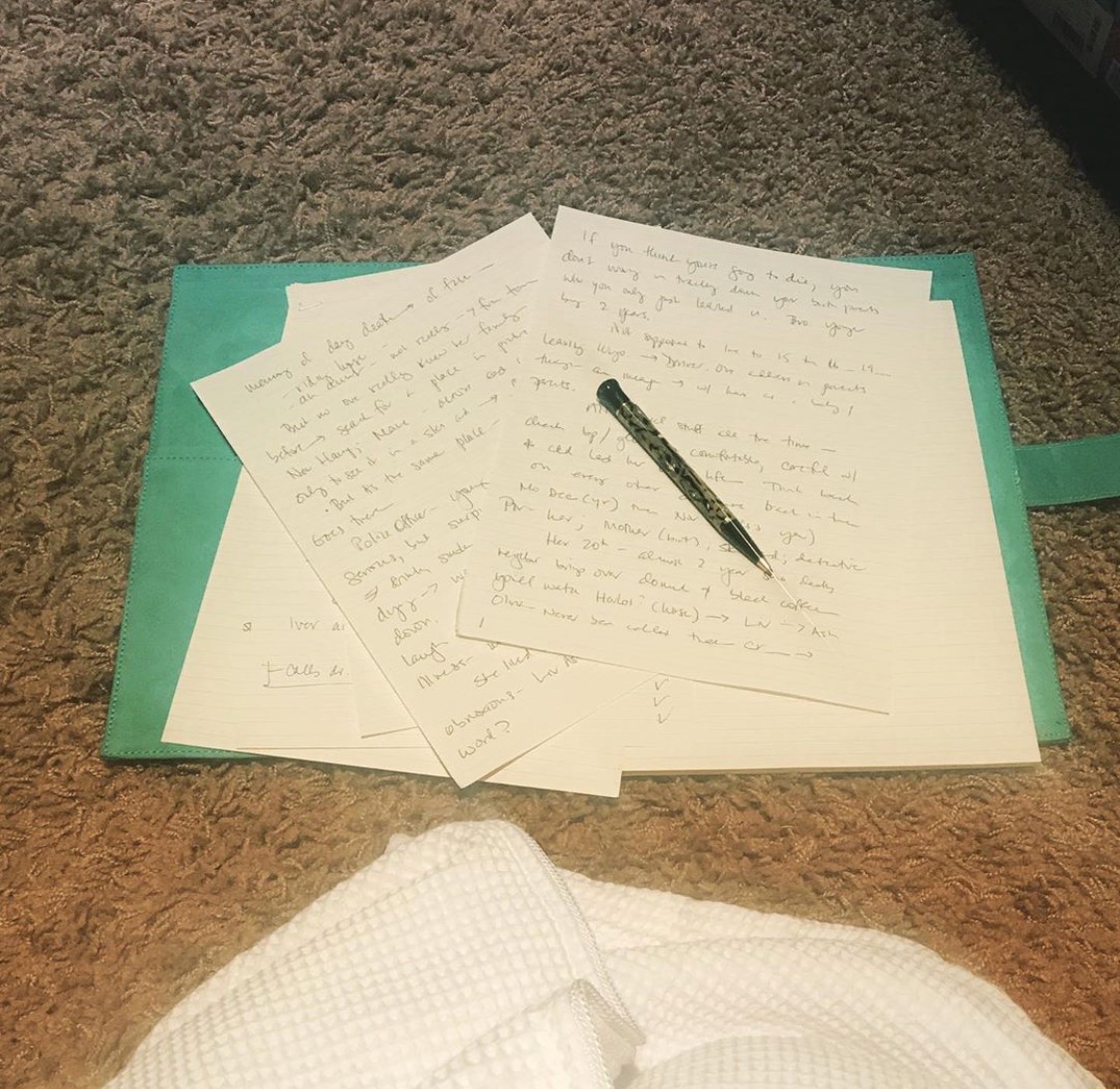
When Inspiration Strikes…
Recently, though I woke up in the middle of the night and was surprised not to find a child standing over me. That’s almost always the reason I wake up. I sat up. No strange noises, no barking or shouting or laughing or sneezing. No vomit. (Always a plus.. you parents know what I mean.)
I’d woken up with an idea. And it felt so alive that some half-asleep part of my brain thought I could get up and right the whole thing that night. Probably not exactly true, but the idea got me out of bed. And for an hour, I huddled on the closet floor in my bathrobe and took notes. I wrote down the snippets of what the characters said, what I saw when Liv Asher drove her old Ram truck with its Wyoming plates and its layers of dust into downtown Denver. I wrote how her dog, Ranger, paced uncomfortably along the truck’s bench seat, whining—perhaps at the unfamiliar sight of bright city lights against the dark sky. Then, I wrote down my ideas for the opening scene, a pregnant woman emerging from some sort of drugged sleep only to discover that she’s no longer pregnant. The baby is gone.
Oh God, she thought. I’ve lost the baby and it wasn’t even mine.
And with that, a new book is born….
The end's laser focus...
Even on a wonderful girls’ holiday, I still found myself coming back to the green notebook, making notes on final scenes, on the big reveal(s), and on those reflective moments that will close the novel.
When the end of a book is in sight, I find it hard to focus on anything else. Which makes it hard to, say, make meals or grocery shop.
Even on a wonderful girls’ holiday, I still found myself coming back to the green notebook, making notes on final scenes, on the big reveal(s), and on those reflective moments that will close the novel.

Although truth be told, I believe that is a half-empty margarita at my feet, so I don’t look too bothered by the work, do I?
Plotter or Pantser
They say there are two types of writers, those who make a long outline and plan it all out and those who write by the seat of their pants.
I have to admit, I’ve tried—and failed—at both.

They say there are two types of writers, those who make a long outline and plan it all out and those who write by the seat of their pants.
I have to admit, I’ve tried both.
And failed at both.
I’m no “pantser.” I need some idea of what is going to happen before I start a book. An outline of at least the first few chapters… and maybe some key plot points further on.
I’m also not much of a "plotter.” Whatever perfect plans I’ve got for my characters, one of them inevitably does something she wasn’t supposed to and there go my plans… up in flames. Or bullets. Or off a cliff.
Well, you get the idea.
So I guess that makes me a plantser… ;)
Tips of the Slung... or Slips of the Tongue
Definition of spoonerism
: a transposition of usually initial sounds of two or more words (as in tons of soil for sons of toil)
What I’ve got isn’t exactly a spoonerism problem although I have yet to find the correct diagnostic term for my particular verbal ailment.
Definition of spoonerism
: a transposition of usually initial sounds of two or more words (as in tons of soil for sons of toil)
What I’ve got isn’t exactly a spoonerism problem although I have yet to find the correct diagnostic term for my particular verbal ailment.
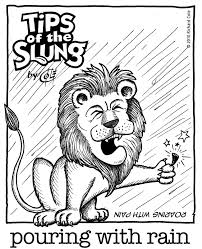
Or roaring with pain…
Whatever it is, it’s definitely from my mother’s side of the family. My mother has trouble remembering the odd names of things and comes up with something just slightly off (and off-putting) like calling someone “Butson” instead of “Watson.”
Or you might go to “Bernie’s” for a nice handbag when really you’d probably go to “Barneys.”
These are a source of endless humor for her four children… The best such story is from when she and my dad were up in Alaska, fly fishing. They were in a little bait shop, in the middle of nowhere and my mom had heard that blood-sucking leaches were doing well as bait. So, standing in front of the old fishermen and the grizzly storeowner, my mom announced. “I think I’l try those cock-sucking roaches today.”
The storeowner, who had surely met all types, said, “I’m afraid I’m not familiar with that pattern.”
Insert hysterical gut laughter from us kids….
Until the day I was at lunch with a girlfriend and we were talking about dream vacations. I told her I’d love to go to Norway or Sweden to see the (what for it)…. areola borealis.
It took me a minute to realize my mistake.
Hiding my red face behind my glass, I corrected myself. “I mean the aurora borealis.”
They said it would happen… I’m becoming my mother!
Making the most of winter... but I'm over winter.
Making the most of winter when you’re really over winter…

The Best Part
It would make sense that the best part of writing book is “The End.” But it’s not.
It would make sense that the best part of writing a book is typing “The End.”
But it’s not.
Or maybe you think it is the moment you hold that first copy in your hands. It may be for some people but not for me.
For me, the best (BEST!) part is seeing the cover. It’s that moment when some other person (one who is much more artistic than I) takes all the things I’ve had in my head for months and months and makes it into a visual piece of art.
I imagine if one of the books is made into a movie, I would have this experience times a million. But for now, the arrival of the cover in that magical moment.
And here is the magic for EXPIRE…
…Now we just have to wait for the release— July 9 can’t come fast enough!

Goals...
Goals. I’m making goals.
Coming through the fog of the holidays—the cards, the presents, the turkey and stuffing, the champagne and sparkling apple cider, the kids out of school and them (and their endless things and clothes and shoes) under foot—it’s time to look at the new year. A new year means a fresh slate.

Like starting a new book, starting a new year invigorates me. I think about all the things I’d like to try. Not do. I no longer make lists that include what I will do this year. Only what I will TRY to do.
So, this year, I’m going to TRY to write two books instead of one. I’m going to TRY to meditate more days than not. I’m going to TRY to read more books than I did last year (which was 80 so that’s going to be a tough one) and I’m going to TRY to put my work away at the end of the day (a reasonable end, not midnight) and be present with my family in the evenings.
What are you going to TRY?
And yes, this is what I look like when I’m making goals… ;)
New new new...
Today is the first day my new website is live. I love new. It’s fresh and clean and, well, new...

Today my new website is live!
New. Fresh. Clean. I love new. The smell of tissue paper that comes in a new pair of shoes. A candle that has never been lit. The fizz of a fresh bottle of seltzer. New is a start, a fresh start. This time of year we’re doing lots of lasts… finishing things up, closing the books. There’s something satisfying about that as well, but new… there’s just not like new.
I just love new.
Winter's Coffee Obsession
In the summer months, I drink a cup or cup and a half and, by then, the day is warm and coffee loses it’s appeal. But in winter…. I’m OBSESSED.
Americans are obsessed with their coffee. I can’t count the times every day that I thumb through social media or Pinterest and see some design in that white foam. Don’t get me wrong. I LOVE my coffee. Growing up, my mom owned a coffee cart inside San Francisco’s federal building. These were early days of the latte—before Starbucks was born. Can you think back that long? But Peet’s was around and when I started drinking coffee (sneaking it as a sophomore in high school and loading it with half and half and sugar), I was drinking Peet’s. And not just Peet’s, which is still the strongest coffee I’ve ever tasted—my dad made it with extra heaps of coffee. “If the spoon doesn’t stand up, it’s not coffee.”

In the summer months, I drink a cup or cup and a half and, by then, the day is warm and coffee loses it’s appeal. I’m not an iced coffee drinker, thank goodness. I would literally pound that stuff and bounce off walls.
But in winter…. I’m OBSESSED. It was mochas, then lattes, then peppermint mochas, then vanilla lattes, then soy vanilla lattes, then cappuccinos. Now, it’s a turmeric latte… huh? I’m afraid it’s not at Starbucks (yet!), but it’s kind of like chai only not as sweet—turmeric and cinnamon goodness, it is truly a new type of heaven.
Until the next thing, of course…
Am I'm stubborn? Or determined...?
As a kid, I was told I was stubborn. I was told this a lot. This was NEVER a compliment.
As a kid, I was told I was stubborn. Mostly this declaration came from my parents and coaches or teachers but occasionally by others as well. My parents’ friends, people in church, folks at the grocery store, babysitters, in clothing stores, at the gas station and the convenience store… well, you get the picture. I was told this A LOT.

This was NEVER a compliment.
Now I’ve got one of those myself—a stubborn son. He’s almost 17. He’s supposed to be stubborn, or that’s what I tell myself when I want to tear out my hair.
But the older I got, the more the terminology shifted from “stubborn” to “determined” or “persistent.” (My husband will still call me stubborn.. and of course my parents. And they aren’t totally wrong… ;)
At what point does stubbornness shift balance to determination?
Is it like the thing where, as a kid on your birthday, you always hoped people would guess you were OLDER than you were… and if they do that to me now, I’m like, “OH, NO YOU DID NOT!!”
Who is that baby?
19 years ago today, I deposited my first royalty check as an author…
It was 19 years ago today that I deposited my first royalty check as an author. It probably goes without saying that it wasn’t a very big check. It wouldn’t cover a month of rent in San Francisco today and it barely covered much back then.
But… my husband and I went to dinner at the Outback Steakhouse to celebrate. I was pregnant with our daughter and craving a blooming onion. If you’ve been to the Outback Steakhouse, you know exactly what I mean.
Hard to believe it was 19 years ago and then I look at my first publicity photo and think,
Who is that baby?!?

1999 Publicity Photo
Huffing for Stuffing
Let’s be honest… it’s all about the pie.
The holidays are about to launch…
My new book proposal is off to my agent(!!)
My daughter is on a plane, heading home from her first semester of college
I’m madly processing laundry and organizing the house (I’d say cleaning but that would be total fiction)
The next week is about reading, relaxing and spending time with close friends because our families are far away, spread across the two coasts…

Our sweet town has a run on the morning of Thanksgiving in support of the local food bank. Huffing for Stuffing. My family usually travels east for the holiday so we’ve never been able to attend. This is our year!!
I figure it I run 5K, I can have a second piece of pie… right?
Because let’s be honest…
It’s all about the pie.
Too old to dress up? Impossible!
I LOVE dressing up for Halloween. Maybe it’s because my brain is always full of crazy characters and it’s fun to act them out. Or maybe it’s because I spend my days alone in the basement and am starving for human attention.
I LOVE dressing up for Halloween. Maybe it’s because my brain is always full of crazy characters and it’s fun to act them out. Or maybe it’s because I spend my days alone in the basement which leaves me starving for human attention.

Whatever the reason, I LOVE LOVE LOVE it. But I have a problem with following directions. (This is true in other areas as well.)
In Halloween costuming, it means I throw something together. I find a crazy feather wreath and turn it into a hat or buy a pair of fake leather pants on super sale and need a way to wear them… Attach a black crow to my arm (not a real one, mind you)
This is SO much fun for me until that moment when someone dressed as an Incredible or a Minion or Peter Pan asks, “What are you?”
To which, I have no good answer… “Uh… crazy raven witch? Bird lady in mourning? Post-apocalyptic Sandra Dee?!”
See below for a close up of my arm ornament which almost put out the eyes of a dozen children. Oops!

Series Sucker...
I'm a sucker for a series... and I LOVE when I discover one where there is more than one book out so I can dive from book #1 right into book #2.
I'm a sucker for a series...
and I LOVE when I discover one where there is more than one book out so I can dive from book #1 right into book #2. The Rachel Carver series is exactly that kind. Rachel Carver is smart, strong while also tender, in the middle of a huge life transition and a little broken--the best kind of character. I loved getting to know her in AMONG THE DEAD and then it was like having dinner with an old friend in DOWN THE BROKEN ROAD. ('cause i read it in one sitting)

Check them out if you haven't already. Plus, the author, Jason, is a really nice guy. That matters, doesn't it?! (It should… ;)
Spatter vs Splatter
In speaking of blood (and other things), "splatter" means to fall or drop as in spots. Spatter, on the other hand, means "to spurt forth in scattered drops, as in blood spattering everywhere."
It's getting to be the end of my writing day. I'm working on the next book in the Dr. Schwartzman series and today, I'm thinking about blood spatter.
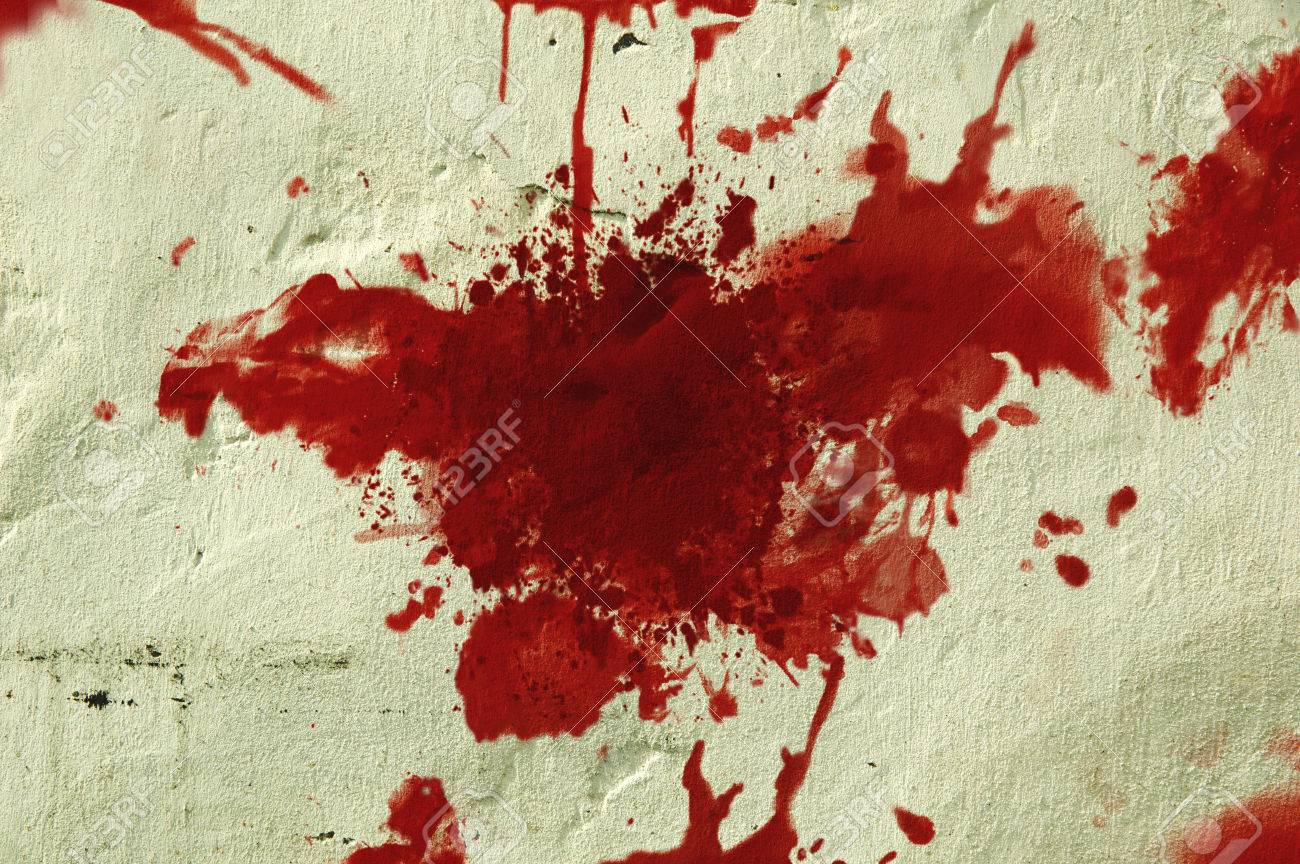
Not splatter. According to MW, "splatter" means to fall or drop as in spots. Spatter, on the other hand, means "to spurt forth in scattered drops, as in blood spattering everywhere." Or "to splash with or as if with a liquid."
To spurt forth, to splash. Now apply that to blood. Blood spurting and splashing.
There's an image, right?
Well, that's the one in my mind right now.
And I'm thinking maybe white wine with dinner tonight...?
Career Authors Guest Post
I consider myself a plot-driven writer. Nothing gets me more jazzed than a twisted murder committed by a shadowy villain.

I consider myself a plot-driven writer. Nothing gets me more jazzed than a twisted murder committed by a shadowy villain. That’s no doubt a good thing for a suspense author. After all, plot is what we hear about most often when readers talk about great thrillers—books that grab them from page one and won’t let them go: this happened and this happened, and it was all so fast and furious.
I can come up with sensational, action-packed stories. So that should make my books brilliant. And so easy to write. Yay, me, right? Except that plot—even brilliant plot—is only half of the equation.
Say what?
What your reader still needs
Creating a memorable story requires a memorable protagonist. She need not be particularly likable or strong or smart… or particularly anything, but the reader must be able to identify with her. And most importantly, the protagonist must fit the story.
Think about it. Plot isn’t what makes us fall in love with stories. What engages us as readers is the journey, riding alongside the protagonist. When absolutely engrossed in the story, we become the protagonist. We bond with them. Seem weird? It’s true.
Even stranger, the bond we form with the characters in a book isn’t just in our minds; it actually circulates through our entire bodies.
Come again?
The science of fiction
Science has proven that stories alter our neurochemistry. When fictional characters interact, our bodies release oxytocin, a neuropeptide first found in nursing mothers that turns up whenever humans feel close to each other. When you read a good story, your body creates a bonding transmitter.
Alone no more
It doesn’t matter if you’re home by yourself in the den with a book. The act of reading makes us step into the place of the character—most often the narrator—and we actually experience that other reality. When characters encounter stress or conflict, we release cortisol, a chemical related to stress response. A happy ending in the story makes our bodies release dopamine. We feel what the characters feel.
What does this have to do with plot?
When we are under the spell of a gripping story, we change with the character. Her perspective becomes the way we see the world, too. To make that possible, the reader has to understand the motivation for what a character does—her choices. Only in understanding the protagonist do her actions have meaning. This understanding is what makes us care. The way our bodies react to a Harry Potter book, for instance, stems from knowing Harry’s plight—the death of his parents, the attack that left him scarred, and all that is still at risk for him while, internally, he yearns for family and home.
Character is key
The character is the reader’s guide, the person we accompany in a whirlwind plot. And we won’t join if the character doesn’t fully engage us. Because we don’t bond. Despite all the hoopla about a brilliant plot, story happens internally, not externally. We don’t come to a story simply to watch events unfold.
We come to experience that story through its characters.
You may come up with a hugely brilliant plot. But for it to succeed, you must find the right character to guide your reader, a character who makes your plot come alive, whose quandaries and challenges grip the reader and won’t let go.
Pick your character carefully.